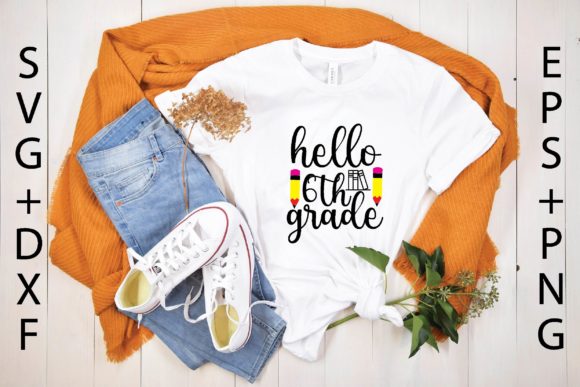
Stitching Confidence: A Designer’s Review of Hello 6th Grade Svg
As an embroidery designer who has spent countless hours digitizing, testing, and refining files for commercial use, I approach every new machine embroidery design with a critical eye. It is not just about whether the image looks cute on a screen; it is about how that design translates to thread, how it behaves under the needle, and ultimately, how it performs in the hands of a customer. Recently, I evaluated Hello 6th Grade Svg, a graphic intended for back-to-school projects, to determine its viability for real-world embroidery project applications.
The first impression of this file is one of playful anticipation. The typography and layout suggest a milestone moment, capturing the excitement of moving up a grade level. For those of us in the craft business, timing is everything. Back-to-school season is a high-volume period for Etsy seller accounts and boutique shops alike. A design like this needs to be versatile enough to appeal to parents looking for personalized gift options while remaining durable enough for daily wear. Visually, the lines are clean, which is a promising sign for stitch clarity, but we must look deeper than the initial aesthetic.
Real-World Application: Beyond the Screen
To truly test the value of Hello 6th Grade Svg, I imagined a specific scenario: a custom order for a local family wanting matching items for their child’s first day of sixth grade. The request included a sweatshirt embroidery piece and a canvas tote bag design. This is a common request in my studio, and it presents unique challenges regarding fabric texture and hoop stability.
When applying this graphic to a heavyweight cotton sweatshirt, the design’s structure holds up well. The bold nature of the lettering allows for solid fill stitch coverage without appearing too dense or stiff. However, when translating this same concept to a canvas tote, the dynamics change. Canvas has a tighter weave and less give than knit fabrics. Here, the design benefits from a balanced stitch density. If the digital file is too dense, it can cause puckering; if it is too light, the fabric shows through. In my assessment, this graphic leans toward a robust appearance, making it ideal for sturdy materials but requiring careful stabilization on lighter goods.
Navigating Fabric and Hoop Constraints
One of the most critical aspects of using any digital embroidery file is understanding its limitations on different surfaces. While Hello 6th Grade Svg is marketed broadly for men, women, kids, and babies, a professional reviewer must advise caution with specific applications. For instance, using this design on a baby embroidery item requires extra scrutiny. Infant skin is sensitive, and bulky stitches can cause irritation. If the design relies heavily on thick satin borders or dense fills, it might be too heavy for a onesie unless backed with a soft, cut-away stabilizer.
Furthermore, consider the hoop size. Sixth graders are growing quickly, and their apparel sizes vary. If you are stitching this onto a youth medium t-shirt, you have ample space. However, if you are attempting to place it on a smaller item, such as a cap or a small patch, you must ensure the smallest details remain legible. Tiny serifs or thin connecting lines in the text can break or become indistinct if scaled down too far. I recommend creating a test stitch-out on scrap fabric at the intended size before committing to the final finished product.
Thread Colors and Visual Appeal
The visual impact of any applique design or standard embroidery relies heavily on color contrast. Since Hello 6th Grade Svg is likely to be used on various garment colors, versatility is key. On dark navy or black shirts, light-colored threads will pop, but you must ensure the underlying fabric does not show through the stitches. Using a matching underlay or a high-quality stabilizer is non-negotiable here. On white or pastel shirts, darker threads provide excellent definition, but you must watch for shadowing effects if the stitch count is high.
For custom apparel businesses, offering mockups in both light and dark variations helps customers visualize the end result. I suggest testing the design in black and white first. If the design loses its shape or readability without color, it may rely too much on color differentiation rather than structural integrity. A strong embroidery design should hold its form regardless of the thread colors chosen.
Commercial Viability and Licensing
For small shop product creators and design assets sellers, understanding the license is paramount. The product description notes that this is an instant download cutting file compatible with software like Cricut and Silhouette. This indicates its primary origin is in vinyl cutting or print-and-cut workflows. As an embroidery professional, I must highlight a crucial distinction: SVG files are vector graphics, not native embroidery formats like PES or DST. To use Hello 6th Grade Svg for machine embroidery, you must either digitize it yourself or use auto-digitizing software, which often yields poor results for text-heavy designs.
If you are an embroidery file purchaser expecting a ready-to-stitch format, verify the file types included. If only SVGs are provided, you are responsible for the digitization process. This affects your pricing and turnaround time. For those who do digitize it, ensure you respect the licensing terms regarding commercial use. Selling printed mockup images or finished garments requires clear rights to the graphic. Always confirm whether the license covers physical sales, digital resale, or both.
Final Verdict for Makers
In conclusion, Hello 6th Grade Svg offers a charming, timely aesthetic that fits well within the T-Shirt Designs and Graphics categories for back-to-school merchandise. Its strength lies in its clear, bold presentation, which translates well to larger hoops and sturdy fabrics like sweatshirts and totes. However, its utility for delicate items like baby clothes or curved surfaces like caps depends entirely on how it is digitized and stabilized.
My advice to fellow designers and makers is to treat this as a starting point. Test it on your specific machines, adjust the running stitch and saturation settings as needed, and always prioritize the comfort of the wearer. When executed with care, this design can become a standout item in your holiday embroidery or back-to-school collection, driving engagement and trust among your customers. Remember, the best commercial embroidery pieces are those that look effortless to the buyer but are engineered with precision by the creator.