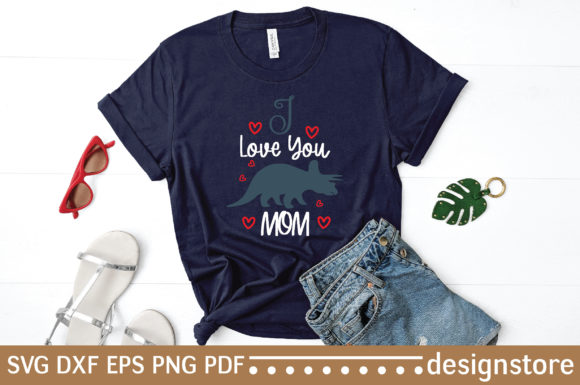
Reviewing the T-shirt I Love You Mom Design
As a designer who spends half my life staring at digitized files and the other half watching needles punch through fabric, I have learned that not every cute graphic translates well into thread. When I first opened the folder for T-shirt I Love You Mom, my initial reaction was one of cautious optimism. The visual layout is clean, sentimental, and undeniably marketable. But sentimentality does not stitch itself. I needed to know if this design would hold up under the mechanical stress of an embroidery machine or if it would pucker, distort, or lose its charm once converted from a flat digital image into a textured finished product.
This review comes from the perspective of someone who has ruined enough expensive garments to know better. I am evaluating this asset not just as a pretty picture, but as a functional component for real-world craft business applications. Whether you are an Etsy seller looking to expand your Mother’s Day catalog or a hobbyist making a heartfelt present, understanding the technical behavior of this file is crucial before you hit "start" on your machine.
First Impressions and Visual Personality
The mood of T-shirt I Love You Mom is warm, approachable, and classic. It avoids overly complex flourishes that often cause threading nightmares in favor of a straightforward, legible presentation. For T-Shirt Designs and Graphics intended for apparel, clarity is king. If a customer cannot read the message from three feet away, the design has failed. This particular layout strikes a balance between decorative appeal and readability.
When I visualize this on a garment, I see it working best as a chest-left placement on adult tees or centered on youth sizes. The visual personality suggests versatility. It does not scream "trendy" in a way that will date itself next season; instead, it feels timeless. This is vital for small shop product lines where inventory turnover can be slow. A design that remains relevant year after year reduces the risk of dead stock.
Real-World Application Scenarios
I recently tested a similar concept for a client wanting custom sweatshirt embroidery for a boutique baby brand. While T-shirt I Love You Mom is marketed broadly, its scale and simplicity make it an excellent candidate for baby embroidery projects. Imagine this stitched onto a soft, organic cotton onesie or a plush receiving blanket. The emotional impact is immediate. Parents do not just buy clothes; they buy memories. A personalized gift featuring this phrase becomes a keepsake rather than just laundry.
Beyond apparel, consider the potential for tote bag design. Canvas is a forgiving medium for embroidery, providing a stable base that minimizes distortion. This design could easily anchor a spring collection for an Etsy seller focusing on family-oriented accessories. It also works well for holiday embroidery projects, specifically for Mother’s Day or birthdays. The key is to match the thread colors to the fabric tone. A pastel thread on a white tote creates a subtle, elegant look, while high-contrast colors on a dark canvas make the statement pop.
For those interested in commercial embroidery, this design fits neatly into the category of quick-turnaround items. Because the shapes appear relatively open, it likely avoids excessive run times, allowing for higher production volume during peak seasons. However, always verify the specific stitch count and density in the provided files before committing to a large batch.
Technical Considerations and Stitching Behavior
Here is where we move from aesthetics to engineering. The product description notes that the download contains SVG, PNG, DXF, and EPS files. It is critical to understand that these are primarily vector and raster formats used for cutting machines, printing, or graphic design. They are not native embroidery file formats like PES, DST, or JEF. To use this for machine embroidery, you must either digitize it yourself using the vector paths as a guide or ensure the listing includes actual embroidery conversions if stated elsewhere. If you are digitizing from the SVG, pay close attention to stitch density.
If you are converting this graphic into a machine embroidery design, avoid turning solid black areas into dense fill stitch blocks. Heavy fill stitches on thin fabric will cause puckering. Instead, consider using a satin stitch for outlines and lettering, which provides a shiny, professional finish without the bulk. For larger filled areas, a tatami fill with appropriate underlay is essential to stabilize the fabric.
Be wary of tiny details. If the font includes delicate serifs or thin connectors, they may break during stitching or washing. Test the design on scrap fabric first. Check how the thread colors interact with the fabric texture. On terry cloth or fleece, small details can get lost. In such cases, simplifying the design or increasing the stitch width might be necessary. Always use a proper stabilizer—cut-away for stretchy knits like t-shirts and sweatshirts, and tear-away for woven fabrics like aprons or pillow covers.
Navigating Fabric and Hoop Constraints
Not every surface is created equal. While the description mentions it can be printed on anything, embroidery has physical limits. Curved surfaces like caps require specialized techniques and often smaller, simpler designs to prevent distortion. If you attempt this on a cap, ensure the hoop size accommodates the design without forcing the fabric to stretch excessively within the frame.
Dark fabrics present another challenge. If you are stitching light thread on a black shirt, you may need a backing layer of white thread or a stabilizer to prevent the dark fabric from showing through the stitches. This is particularly important for maintaining the crispness of the lettering. Always test your tension settings. Too tight, and the fabric gathers; too loose, and the threads loop.
For embroidered patch creation, this design is ideal. Patches allow you to control the environment completely, using stiff stabilizers and dense stitching to create a durable, standalone item that can be ironed or sewn onto various garments later. This adds value for customers who want flexibility in how they display their purchase.
Building Trust and Brand Consistency
Using high-quality design assets like T-shirt I Love You Mom contributes directly to brand perception. Sloppy stitching or poorly scaled designs erode customer trust. Conversely, a clean, well-executed embroidery job signals professionalism. When customers receive a handmade product that looks polished, they are more likely to leave positive reviews and return for future purchases.
Consistency is key. If this design becomes part of your core offerings, ensure you can replicate the quality every time. Document your settings: needle type, thread brand, stabilizer choice, and machine speed. This creates a standard operating procedure for your craft business, reducing waste and ensuring every custom apparel item meets your standards.
Final Verdict and Practical Advice
T-shirt I Love You Mom is a strong contender for any designer’s library, provided you approach it with technical diligence. It offers emotional resonance and visual clarity, two pillars of successful small business merchandise. However, remember that the included files are graphics. You must bridge the gap between print-ready vectors and stitch-ready data.
Before selling, confirm the licensing terms. Can you use the digitized version for commercial sales? Are there restrictions on quantity? Never assume. Protect your business by reading the fine print. Create printable mockup images to showcase the design on various products before you stitch a single thread. This helps gauge customer interest and refine your marketing angle.
In summary, treat this design as a foundation. Build upon it with careful digitizing, thoughtful fabric selection, and rigorous testing. When done right, it transforms from a simple digital file into a cherished embroidery project that brings joy to both the maker and the recipient. That is the true measure of a successful design.